Background
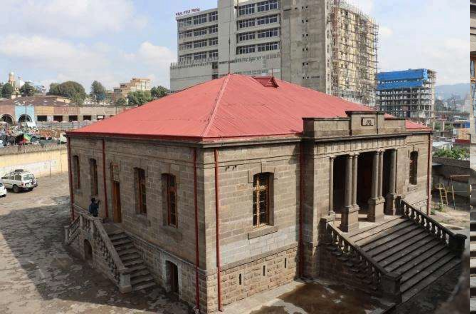
American Ghibbi, a majestic stone building in the Mercato area, was completed in the mid-1910s for the Minister of War, Fitawrari Habte Giyorgis Denagdé, who at the time lived in the vicinity with his entourage and owned much land and property. He used to live in a house on the site where the St. Raguel Church now stands.[1] In September 1935, the building became the official home of Cornelius Van H. Engert, the American Minister Resident in Ethiopia,[2] and subsequently served as the American Legation until February 1937. This distinguished building possesses a rich and significant history.
The failed assassination attempt made against the Viceroy of Italian East Africa, Marshal Rodolfo Graziani on February 19, 1937 was followed by a three-day massacre in Addis Ababa.[3] During this time, Italian fascist militias, known as Blackshirts, and civilian laborers murdered thousands of Ethiopians.[4]
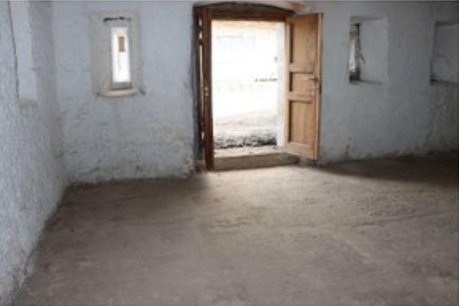
During the violence, Ethiopians living near American Ghibbi fled to the American Legation for safety. The American Minister Resident, Cornelius Engert, made the principled humanitarian decision to provide shelter to those in need. About seven hundred Ethiopians--248 men, 262 women, and 195 children took refuge within the legation between February 19 and 23.[5]
Defiance and Diplomacy
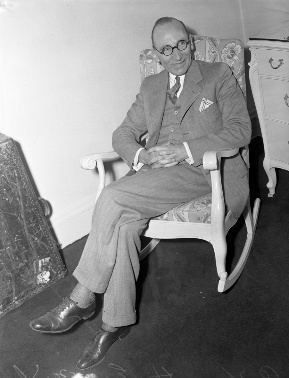
In a telegram dated February 23, 1937, the U.S. Secretary of State informed Minister Resident Cornelius Engert that, although the Department recognized the humanitarian grounds for sheltering the displaced people within the property, their presence increased the risk to him and his staff. He was therefore advised to arrange for their departure as soon as it could be done without putting their lives in danger.[6] However, Engert prioritized the safety of the displaced and declined to allow their departure until he had secured firm guarantees of their safety from the Italian authorities.[7] Only after obtaining these assurances did the displaced begin to leave, with the final group departing on February 26.[8] With regard to their fate, subsequent reports are conflicting. The American Consul reported to the State Department that he knew of no cases of mistreatment of members of this group. Yet, according to eyewitness accounts reported to Parliament by a British MP, members of the group were attacked after leaving the legation.[9]
In 2021, 84 years after the massacre, the Public Affairs Section of the American Embassy in Addis Ababa used a small grant to recruit a local NGO, Heritage Watch Ethiopia, an organization advocating for the protection and promotion of built heritage, to locate and record testimonies from the descendants of the “Saved Seven Hundred” Ethiopians.[10]
Rediscovering the Survivors

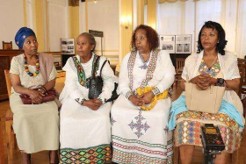
Locating the descendants of the survivors proved to be difficult from the outset. Many of the elders who had firsthand knowledge had passed away, and the more recent displacement of families from neighborhoods in Addis Ababa further disrupted the continuity of these stories. As a result, the experience of American Ghibbi was, for a long time, largely forgotten or preserved only within fragmented family accounts. However, the researchers’ decision to focus on religious associations, such as the "Senbete Mahber," was a strategic move that led to important findings. By engaging with these community groups, the team identified its primary informant, Ato Mitiku Gebre-Mikael, who was recommended by his sister, Weizero Sakamyelesh Gebre-Mikael, whose father had been a founding member of the "talaqu yesenbete mahber" at Debre Amin Tekle Haimanot Church. Ato Mitiku provided the names of three individuals whose parents had resided near the American Ghibbi, which eventually led the team to a man named Taye. He confirmed that his father, Ato Gebre-Mikael Gebriyé, and his wife, Weizero Alemitu Gebru, had been sheltered at the legation; their names were later confirmed as entry No. 99 on the original displaced list. Furthermore, the researchers successfully located the daughter and grandchildren of Ato Tegegne Imru and his wife, Weizero Wossené Aboyé, who were recorded as entry No. 100 on the same historic list.[11]
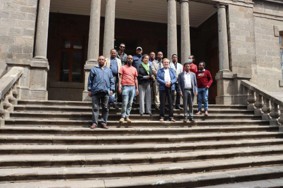
On February 22, 2022, the Public Affairs Section organized a public event at American Ghibbi featuring a panel of experts, including the renowned Ethiopian architect Fasil Giorghis, who described the history of the building; Ian Campbell, who vividly recounted the story of Engert; and the director of Heritage Watch Ethiopia, Princess Esther Antohin, who presented the research findings and invited the children and grandchildren of the survivors to attend the event in the very building where their parents' lives had been saved 85 years ago.[12]
References
1. We obtained this information from FikreSillasie Sifir, a conservation architect and project coordinator during the two-and-a-half-year restoration work of the building between 2021 and 2023.
2. The Saved 700. (2023, July). State Magazine. https://statemag.state.gov/2023/07/0723feat04/
3. The British independent scholar Ian Campbell has authored four definitive volumes documenting the atrocities committed by Fascist Italian forces following the events of February 19, 1937. These works include: The Plot to Kill Graziani (2010), which analyzes the complete history of the assassination attempt; The Massacre of Debre Libanos (2014), detailing the execution of thousands of clergy; The Addis Ababa Massacre (2017), the comprehensive account of the three-day slaughter of civilians in the capital; and Holy War (2021), which examines the Vatican's role during the Italian occupation.
4. In a Zoom interview conducted by Heritage Watch Ethiopia on July 1, 2022, Ambassador Imru Zelleke, an eyewitness, recounted the horrific period of massacre and violence. He said, "Thousands were killed or maimed by Italian forces, who used guns, bayonets, knives, and even picks and shovels to kill people regardless of age or gender." He also wrote about it in his memoir, A Journey: Memoirs, published in 2016, P. 29
5. U.S. Department of State. (1954). Foreign relations of the United States, 1937 (Vol. 2). p. 682 & 684
6. Ibid. P. 686
7. Ibid. P. 682
8. Ibid. P. 684
9. Campbell, Ian. (2017). The Addis Ababa massacre: Italy’s national shame. Oxford University Press. p. 235
10. The Saved 700. (2023, July). State Magazine. https://statemag.state.gov/2023/07/0723feat04/
11. Heritage Watch Ethiopia. (2023). Revisiting narratives of Yekatit 12, 1937
12. The Saved 700. (2023, July). State Magazine. https://statemag.state.gov/2023/07/0723feat04/
Sources
Ian Campbell. (2017). The Addis Ababa massacre: Italy’s national shame. Oxford University Press.
Imru Zelleke (2016). A journey: Memoirs. CreateSpace Independent Publishing Platform.
Heritage Watch Ethiopia. (2023, March 20). Revisiting narratives of Yekatit 12, 1937: In search of survivors at the American Ghibbi (Unpublished report).
U.S. Department of State. (2023, July). Saved 700: Remembering a heroic act in Addis Ababa. State Magazine. https://statemag.state.gov/2023/07/0723feat04/
U.S. Department of State. (1954). Foreign relations of the United States diplomatic papers, 1937: The British Commonwealth, Europe, Near East and Africa (Vol. 2). U.S. Government Printing Office.